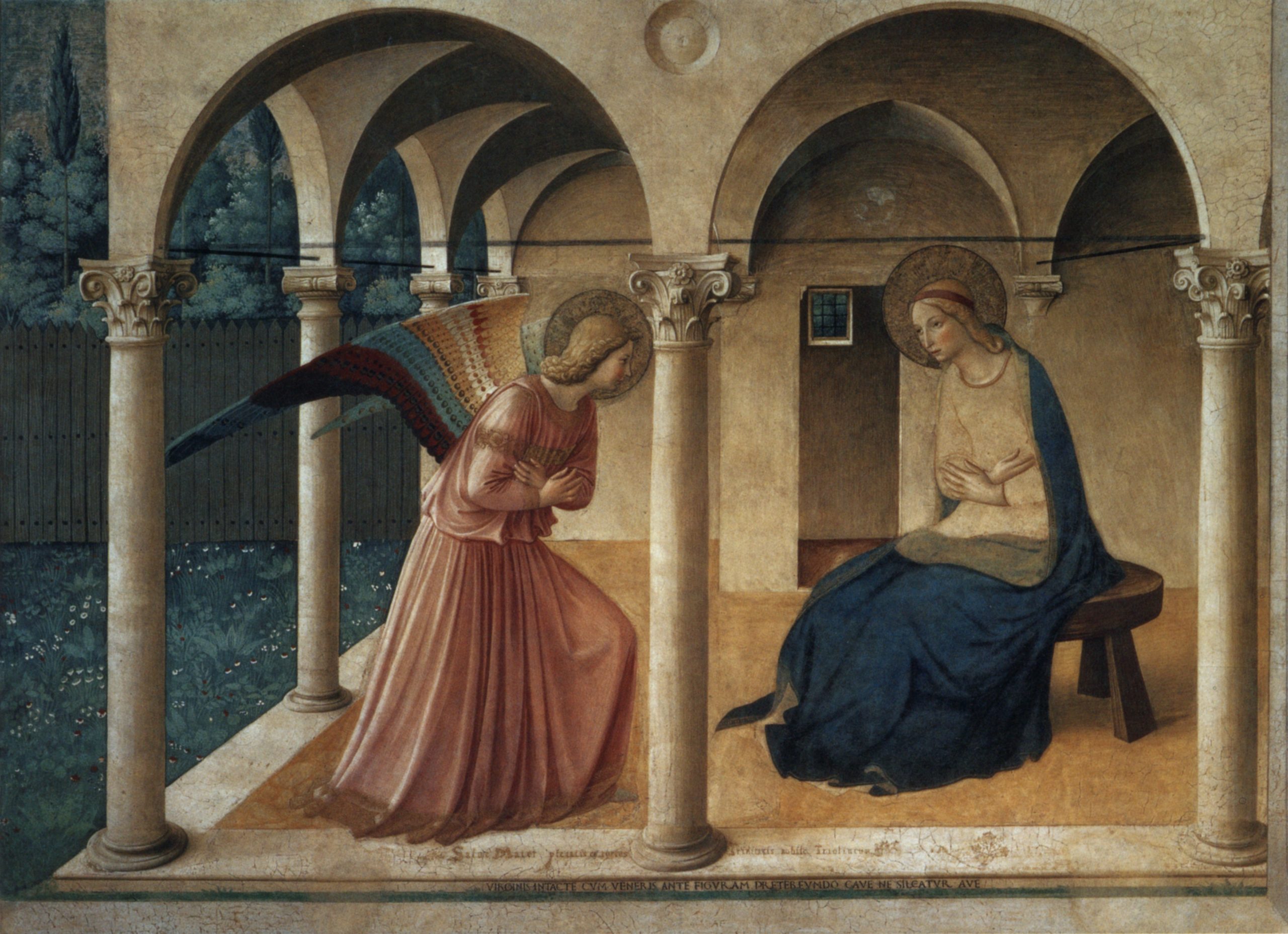
Fra Angelico, The Annunciation (c. 1440, San Marco, Florence)
Fra Angelico paints the moment when the Word becomes flesh — the ultimate instance of spirit taking on bodily form. Mary’s posture (arms crossed, receptive) mirrors how matter receives form. The angel Gabriel stands outside her cell, and the light of the Holy Spirit descends.
What it communicates:
- The Incarnation is Aquinas’s proof that body and matter are not evil or disposable — God himself took on a body.
- Mary’s fiat (“let it be”) shows the cooperation between spirit and matter — the soul doesn’t force itself on the body; the body receives and is elevated.
- As the Catechism puts it, “the incarnation of the Son of God has ushered in a new ‘economy’ of images” — we can now depict the invisible God because He became visible .
Just what is “body” and “soul”?
The human supposit, viz, man, is composed of body and soul. The body is the material element in the composite and it individuates one person from another. The soul is immaterial and consequently, immortal (Immortality is a proper conclusion to something being immaterial). Soul is defined as “the first principle of life in those things which live among us” (“primum principium vitae in his quae apud nos vivunt) and in the case of man who is a rational animal (the definition of man as a rational animal is common to the school of philosophy, see Aristotle, Politics, 1. 7 c 13) (1332a42-1332b7), the soul is the substantial form of the body (For Catholics, one cannot hold a position which rejects that the soul is the substantial form of the body), making the body to be a human body rather than some other thing. As the substantial form of the body, it has its own existence which it communicates to the body.
- Introduction to the Science of Mental Health, Fr. Chad Ripperger, Sensus Traditionis Press, Casper, WY 82604, 4th edition, 2022, p. 14
Analysis by Webb Online – Investigate Document Collections
This is dense Scholastic philosophy, but the core ideas are remarkably clear once you break them down. Let me walk through the paragraph piece by piece, using Aquinas’s own words to clarify what’s going on.
The Core Question: What Is a Human Being?
Aquinas is giving you an answer that rejects two extremes. On one side are materialists who say we’re just bodies — nothing spiritual. On the other are Platonists who say the soul is just “riding” the body like a pilot in a ship, only loosely connected. Aquinas, following Aristotle, says neither. The human being is a unity — one substance made of two principles: body and soul.
“The body is the material element… it individuates one person from another”
This is the easiest piece. Think about it this way: you and your friend both have a “human nature” — you’re both rational animals, both made of body and soul. So what makes you you and not your friend? It can’t be the soul, because souls are immaterial and don’t have physical location or dimensions. What separates you is your body — specifically, matter under particular dimensions (this specific chunk of flesh, these bones, this DNA).
Aquinas calls matter the principle of individuation. Your body is what makes you this human rather than that human. Without it, all human souls would be indistinguishable — which is, in fact, what Aquinas thinks happens after death (souls are individuated only by their former relation to a particular body, awaiting resurrection).
“The soul is immaterial and consequently, immortal”
This is a tight logical chain in Aquinas. Here’s how it runs:
- The soul is immaterial. Why? Because the intellect can know all material things. If the intellect itself were material (like your eye is a physical organ), it would have a specific physical nature that would limit what it could perceive — just as your eye can’t hear. But the intellect can understand the nature of everything. Therefore, it cannot have a material nature. It must be immaterial .
- What is immaterial cannot be corrupted. Corruption happens when a composite thing breaks apart into its components. But the soul has no parts — it’s simple (not made of smaller pieces). So there’s nothing to break apart. Hence, it’s immortal .
As Aquinas puts it in the Summa, “the human soul retains its own existence after the dissolution of the body; whereas it is not so with other forms” . Your dog’s soul (the sensitive soul) ceases to exist when the dog’s body dies, because it has no operation independent of matter. Your intellect does have an operation independent of matter — understanding — so it can exist on its own.
“The first principle of life in those things which live among us”
Aquinas takes this definition of soul from Aristotle. Let’s unpack the phrase carefully.
“First principle of life” — The soul isn’t just one of the things that keep you alive, like your heart pumping blood. It’s the first or primary principle — the foundational source from which all your living activities flow. Aquinas clarifies: the eye is a principle of vision, but the eye isn’t the soul. The soul is what makes the whole organism be alive in the first place .
“In those things which live among us” — This qualifier matters. Aquinas is being careful not to overstep. He’s talking about the kind of life we can observe: plants, animals, humans. Whether angels or God “live” in the same sense is a separate question (he thinks they do, but in a higher way).
The point: when you see something moving itself, growing, reproducing, sensing, or thinking — all of that traces back to a single principle within it. That’s the soul.
“Man is a rational animal”
This is the classical definition of a human being that Aquinas inherits from Aristotle (Politics 1.7). It’s a genus-difference definition:
- Animal = the genus (the broad category you belong to). You share this with dogs, cats, birds. You have a body, you’re alive, you sense, you move yourself.
- Rational = the specific difference (what distinguishes you within that category). Your animality is shaped and informed by rationality — the power to think abstractly, to reason, to know universal truths, to make free choices.
So a human is not “a rational thing that happens to have a body” nor “an animal that happens to think.” We are rational animals — one integrated nature where rationality informs and elevates our entire animal existence.
“The soul is the substantial form of the body”
This is the technical heart of the paragraph, and the hardest concept.
What is a “substantial form”?
In Aristotelian philosophy, every physical thing is a composite of matter and form:
- Matter = the underlying stuff, pure potential. By itself, it’s nothing in particular.
- Substantial form = the organizing principle that makes that stuff be what it is. It gives the thing its essence — its “whatness.”
For a rock, the substantial form makes this hunk of stuff be a rock. For a tree, it makes it be a tree. For a human, the substantial form is the rational soul — and it makes this body be a human body, not just a pile of organic chemicals .
Aquinas says something remarkable: there is only one substantial form in a human being. You don’t have a “body form” that makes you a body, then a “living form” that makes you alive, then a “sensitive form” that makes you an animal, then a “rational form” that makes you human. The rational soul does all of that. It virtually contains the vegetative and sensitive powers within itself .
Why does this matter? Because if the soul is just one form among several in you, then you wouldn’t really be a unity — you’d be a stack of forms glued together. But you are one thing. When you stub your toe, you feel pain — not “your body” separately from “your soul.” That unity is only possible if the soul is the single substantial form of the entire body.
What does this mean for mental health?
This is where it gets directly relevant to your interest in the spiritual context of mental health. If the soul is the substantial form of the body, then:
- You are not a soul trapped in a body. You are a unified composite. Your thoughts are not merely “spiritual” events — they involve your whole embodied self. Your body is not a prison; it’s part of what you are.
- Disorders of the body affect the soul. Because the soul animates the body as its form, a chemical imbalance, brain injury, or hormonal disruption genuinely affects the person’s capacity to think, feel, and choose. This isn’t a “spiritual failure” — it’s the natural consequence of being an embodied soul.
- Disorders of the soul affect the body. Conversely, despair, anxiety, and spiritual dryness produce real physical effects.
Aquinas’s framework gives you a way to take both biological psychiatry and spiritual direction seriously — because the soul and body aren’t two things accidentally glued together. They’re one substance. You can’t treat one while ignoring the other.
“It has its own existence which it communicates to the body”
This is the final piece and it’s subtle. Most substantial forms don’t have their own existence — they exist only in the matter they inform. The form of a rock ceases to exist when the rock is crushed. But the human soul is subsistent — it has an act-of-existence that belongs to it, not just to the composite .
Here’s how Aquinas puts it: “The soul communicates that existence in which it subsists to the corporeal matter, out of which and the intellectual soul there results unity of existence; so that the existence of the whole composite is also the existence of the soul” .
In plain English: The soul already has existence (it’s a thing that exists, not just a feature of something else). When it’s united to a body, it shares its own existence with that body. The body doesn’t have a separate “body-existence” that the soul then rides on top of. The soul’s act of existence becomes the act of existence of the whole person. That’s why when the body dies, the soul keeps existing — it was never dependent on the body for its existence in the first place.
Putting It All Together: What You Are
Here’s the picture Aquinas is drawing:
| Element | Role | Property |
| Body (Matter) | The material principle; makes you this person | Corruptible, individuating |
| Soul (Substantial Form) | The formal principle; makes you a person (a human being) | Immaterial, immortal |
| You (The Composite) | One unified substance — a rational animal | Fully body, fully soul, one thing |
Your soul isn’t in your body like a marble in a box. It’s the act by which your body is a living human body. And your body isn’t an accessory to a purely spiritual you — it’s as much you as your soul is. That’s why Christianity teaches the resurrection of the body, not just the immortality of the soul. The body belongs to who you are.
Implications for Understanding Mental Health in a Spiritual Context
This framework gives you a powerful tool:
- Depression isn’t just “spiritual.” Because the soul informs the body, bodily states (inflammation, neurotransmitter imbalances, sleep deprivation) genuinely affect the soul’s operations — including intellect and will. Augustine and Aquinas were aware of this long before modern neuroscience.
- But it isn’t just “biological” either. Because the soul is the form of the body, what happens in your intellect and will (beliefs, choices, habits of thought) shapes your body in return. Spiritual practices, confession, therapy, and community are real interventions in a psychosomatic unity.
- “Mental health” is a misnomer in a way. It’s really personal health — the health of a unified body-soul composite. A purely pharmaceutical approach misses the person. A purely spiritual approach that ignores the body’s material reality also misses the person.