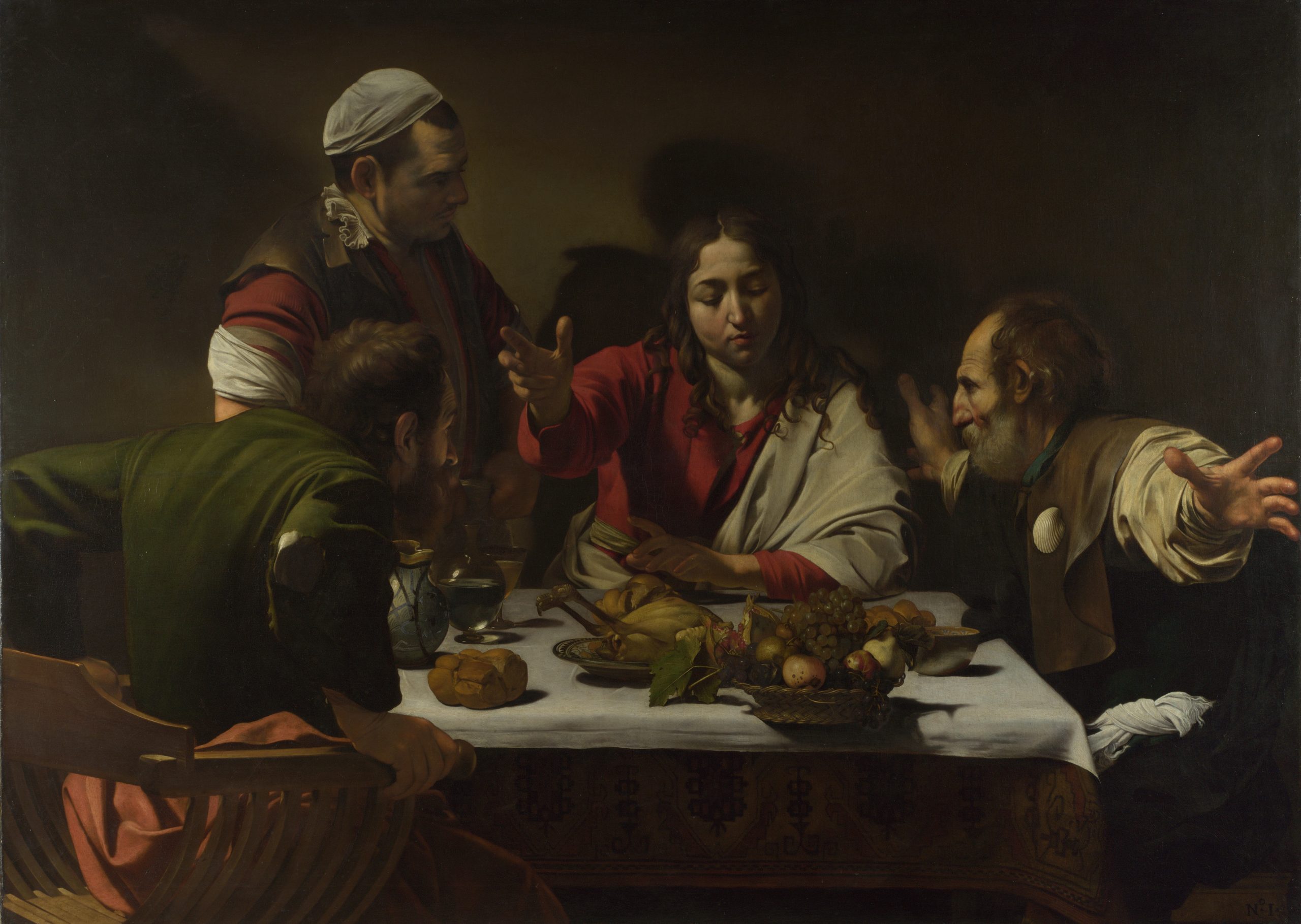
In the Gospel of Luke chapter 24, two of Jesus’ disciples meet him on the road to a town called Emmaus. He interpreted for them all of the recent events, identifying how the Old Testament foretold Jesus and the ‘pattern’ of what the Messiah would look like. I’d like to see what was understood by early church fathers and other renown saints.
Was it not necessary that the Christ would have to suffer these things to enter into His glory and are there writings that reflect on all of them finding fulfillment in the Eucharist the template, and in the Liturgy we replicate the story of Jesus, and in the moment we get the pattern, and we see Him
The Emmaus Pattern: How Christ Opens the Scriptures
The account from Luke 24 is preserved across multiple textual traditions— the KJV 1611 , the Latin Vulgate , the Greek New Testament (SBLGNT) , and Tatian’s Diatessaron — all of which capture the same essential structure: Luke 24:27 tells us Jesus “beginning at Moses and all the prophets, expounded unto them in all the scriptures the things concerning himself.” The Diatessaron renders it as: “He began from Moses and from all the prophets, and interpreted to them concerning himself from all the scriptures” .
The key verse for the question — “Was it not necessary that the Christ would have to suffer these things and to enter into His glory?” (Luke 24:26) — is rendered in the Latin Vulgate as “nonne haec oportuit pati Christum et ita intrare in gloriam suam” . This is the hermeneutical key: suffering precedes glory, and the entire Old Testament was read through that lens.
The Pattern Emerging
What’s already clear from the material retrieved is that the fathers read these types not as loose allegories but as a coherent divine pedagogy — a pattern woven into history itself. As Augustine puts it, the key is that all such interpretations “must be referred to this city of God we speak of, which sojourns in this wicked world as in a deluge” . And as Jerome notes, Philo’s failure to see Christ in the types is the veil that remains until “they turn to the Lord” .
The Emmaus road is itself the paradigm: Jesus doesn’t just cite proof-texts; He “beginning at Moses and all the prophets” shows a continuous pattern — a necessity that the Christ must suffer and enter His glory. The fathers saw this pattern woven into every major figure of the Old Testament, and they saw its culmination not just in the historical events of Jesus’ life, but in the Eucharist (where He is “known in the breaking of the bread”) and in the Liturgy (where the pattern is re-presented).
Abraham and Isaac — The church fathers read the binding of Isaac (the Akedah) as the central type of the Father’s sacrifice of the Son. Abraham carrying the wood, Isaac bearing the wood up Mount Moriah, the ram caught in the thicket — all of these were read Christologically. Irenaeus, Augustine, and especially Melito of Sardis (in his Paschal Homily) develop this. The dataset’s ANF volumes almost certainly contain these.
Jacob’s Ladder — Jesus’ saying in John 1:51 (“You will see heaven opened, and the angels of God ascending and descending on the Son of Man”) directly invokes Genesis 28. The church fathers read this as Christ being the true ladder — the mediator between heaven and earth. Justin Martyr, Irenaeus, and Augustine all develop this. I need to search the ANF and NPNF texts specifically for this.
Moses — The typology of Moses as lawgiver and Christ as the new lawgiver who brings not tablets of stone but the Spirit is developed extensively by Paul in 2 Corinthians 3, and the fathers follow suit. Chrysostom’s homilies on this are likely in the NPNF series.
David — The king who conquers Goliath prefiguring Christ conquering sin and death on the cross. The Psalms themselves — especially Psalm 22 (“My God, my God, why have you forsaken me?”) — are read by the fathers as David speaking prophetically in the person of Christ. Augustine’s Enarrationes in Psalmos may be in the collection.
Jonah — Jesus explicitly names this sign in Matthew 12:40. The fathers (especially Augustine, Jerome, and Chrysostom) develop the three days in the belly of the fish as the clearest type of the three days in the tomb.
Isaiah 53 and the Suffering Servant — This is the foundational proof-text for virtually all patristic Christology. Justin Martyr’s Dialogue with Trypho (in ANF Vol 1) devotes extensive attention to it. The entire patristic tradition reads the Suffering Servant as Jesus.
Jeremiah’s New Covenant — Jeremiah 31:31-34, cited in Hebrews 8-10, is the basis for the Eucharistic words “This is the cup of my blood, the new covenant.” The fathers develop this as the fulfillment of Jeremiah’s prophecy.
Zechariah 12:10 (“They shall look on him whom they pierced”) — Quoted in John 19:37. The fathers connect this to the piercing of Christ’s side and the flow of blood and water, which they read as the sacraments of the Church.
The Eucharist and Liturgy — The Emmaus story itself — “He was known to them in the breaking of the bread” — is the great Eucharistic coda. The fathers (especially Ambrose, Cyril of Jerusalem, and Chrysostom) read the entire pattern of Exodus, Passover, manna, and sacrifice as finding its telos in the Eucharist.